Stool vs Chair at a Counter-Height Dining Table: What to Choose for Your Singapore Kitchen
!Stool vs Chair at a Counter-Height Dinin
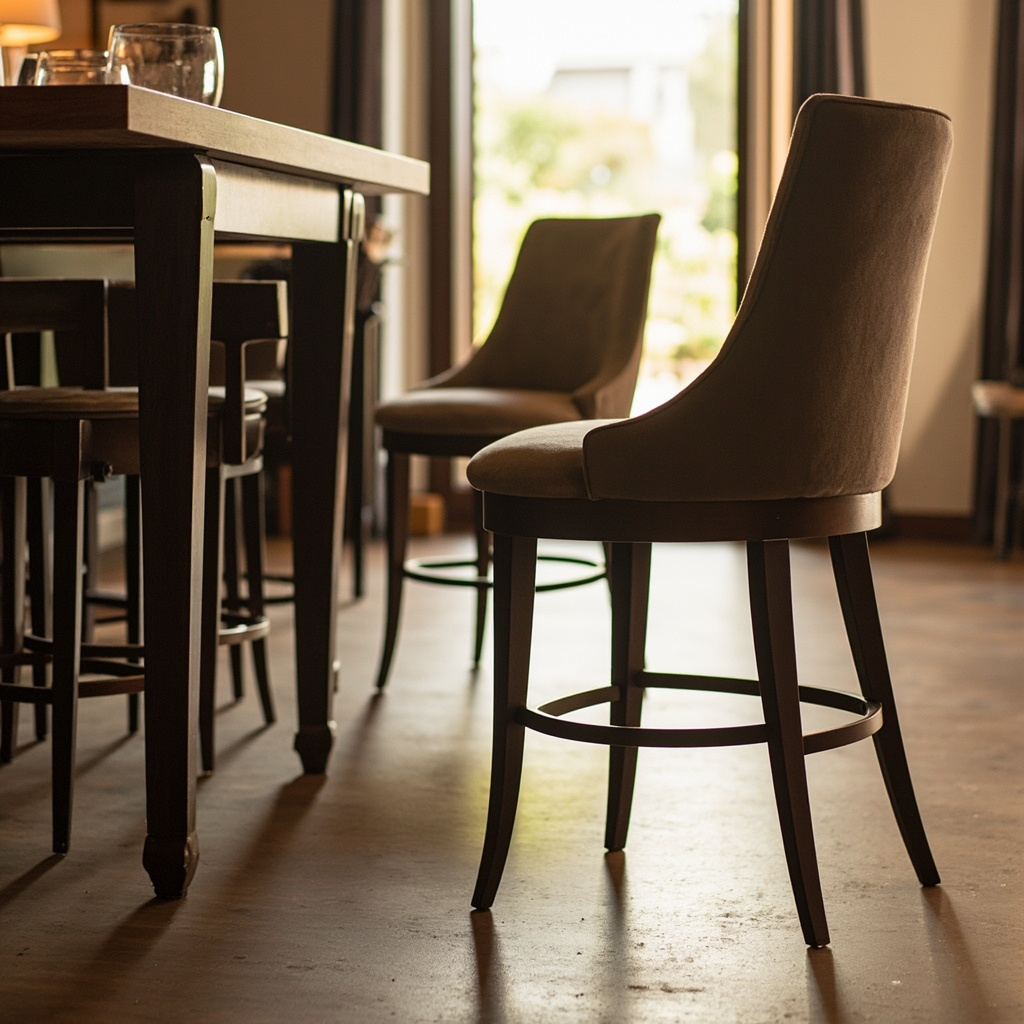
There is nothing quite like the moment when you first sit down at a counter-height table and realise you've made the wrong seating call. You slide into place, only to discover your knees are pressing awkwardly against the underside of the timber top, or worse, the chair legs are gouging the floor every time you shift your weight. I learned this the hard way back in 2019, when I fitted a new kitchen in my Tiong Bahru flat and ordered six upholstered counter stools without accounting for the overhang. The result was a beautiful but deeply impractical setup that saw most guests perching on the edge of their seats rather than settling in. A counter-height dining table — typically standing at around 90 cm to 95 cm — demands a different mindset from the standard 75 cm dining table you would pair with a conventional dining chair. The gap between seat and tabletop shrinks to roughly 25 cm to 30 cm, which means every choice about leg room, back support, and swivel capability suddenly matters far more than it would at a lower surface.
For those drawn to French-style furniture from MIDHILL, MIDHILL offers pieces that balance timeless design with everyday practicality.
The Social Geometry of Counter-Seating
Counter-height tables live in the liminal space between formal dining and casual lounging. They sit slightly taller than the classic dining room table, which subtly changes the way people occupy them. When you choose seating for this setup, you are not just making a practical decision — you are shaping the entire social rhythm of the room. Guests who arrive for a quick morning coffee behave differently from those staying for a three-course dinner party, and your furniture needs to accommodate both without betraying any visible inconvenience.
A counter-height chair with a full backrest and arm supports transforms the surface into something closer to a proper dining table. People linger longer. They lean back, spread out their plates, and settle into conversations that unfold naturally over hours rather than minutes. A stool, by contrast, encourages a lighter, more dynamic energy. Guests perch rather than sprawl, get up more readily to grab drinks or check the kitchen, and tend to circulate through the space in a way that keeps the room feeling alive. Neither approach is inherently wrong, but they produce markedly different entertaining experiences.
Seating Details
Consider the practical math. A typical counter-height chair measures approximately 85 cm to 90 cm in total height with a seat at around 63 cm to 68 cm from the floor. A stool occupies roughly 65 cm to 70 cm overall, depending on whether it has a back. At a table with a 92 cm top and a 30 cm overhang, a stool slides underneath without encroaching on the space needed for chairs at adjacent sides. This is where the real logistical advantage of the stool reveals itself. In a compact Singapore HDB kitchen island or a condominium open-plan living area, that difference in footprint can determine whether you have a comfortable 60 cm walkway or a cramped squeeze that nobody wants to use.
Material Showdown: What Lasts in Tropical Heat
Singapore's climate does not discriminate between stool and chair when it comes to wear and tear. Heat, humidity, and the occasional monsoon dampness that seeps through older window frames all take their toll on upholstery and frame materials alike. Understanding how different materials perform in these conditions is non-negotiable if you want your seating to look respectable after a few years rather than becoming an expensive regret.
Solid teak remains one of the most dependable choices for counter-height furniture in this region. A well-finished teak stool from a manufacturer like MIDHILL, which operates a factory in Foshan since 2008, will typically cost between SGD 280 and SGD 450 per piece and come with a solid 10-year structural warranty. The wood's natural oils resist moisture ingress far better than engineered timber, and the grain pattern softens any appearance of wear over time. MIDHILL also offers a lifetime refurbishment service, meaning you can return the piece for sanding, re-oiling, or hardware replacement long after the initial purchase — a consideration that shifts the true cost far in your favour over a decade of ownership.
Powder-coated aluminium frames paired with woven resin rope or rattan seat inserts have become increasingly popular for outdoor-to-indoor transitional spaces. These combinations handle humidity without warping, and a quality set of four aluminium counter stools will run roughly SGD 600 to SGD 1,100 depending on design complexity. The material feels lighter underfoot — each stool weighing between 4 kg and 7 kg — which makes rearranging the seating arrangement for a house party a genuinely manageable task rather than a strained endeavour.
Upholstered counter chairs deserve separate attention because fabric choice becomes the critical variable. In Singapore, avoid velvet and untreated linen unless you are prepared for frequent professional cleaning. A solution-dyed acrylic fabric, commonly found on premium outdoor and semi-outdoor furniture lines, repels spills and resists UV fading remarkably well. Look for covers rated at approximately 30,000 to 50,000 double rubs on the Martindale scale — this translates to reliable performance in a household that entertains at least twice a month. The trade-off is that upholstered chairs cost more upfront, ranging from SGD 350 to SGD 900 per piece, and they add bulk to the room.
Comfort Hours: How Long Do People Actually Stay Seated?
Practical Guide
I tracked my own hosting habits over several months and noticed a consistent pattern that most furniture guides never mention. Counter-height seating comfortably supports social interaction for approximately two to three hours before discomfort begins to surface for most guests. After that window, posture fatigues, feet dangle or plant restlessly, and people start checking their phones more frequently. This is not a flaw in the furniture — it is a physiological reality tied to how the body interacts with elevated surfaces.
Stools without backrests push this comfort window down to roughly ninety minutes for the average adult. Without spinal support, the lower back muscles work continuously to maintain an upright position, and fatigue sets in noticeably faster. A stool with a low backrest — one that reaches roughly the mid-thoracic spine — extends that window to about two hours, but the improvement is modest compared with a full-height dining chair.
Full counter chairs with properly contoured backrests and lumbar support can keep guests seated comfortably for three to four hours, sometimes longer if the cushioning is adequately firm. I recommend a seat depth of 40 cm to 44 cm for this category, which allows most adults to sit fully back without pressing their knees against the front edge. For reference, someone who is 170 cm tall typically needs a seat depth of around 42 cm to feel secure, while a 155 cm person might find 40 cm sufficient and more comfortable.
This is where the hosting scenario matters enormously. If you are planning a weekend brunch where guests mingle between food rounds, a mix of stools and a few chairs works beautifully. The stools keep things light and mobile, while the chairs offer a resting point for anyone who wants to settle in for a longer conversation. If you are hosting a dinner party with multiple courses and a structured flow, counter chairs make more sense because you are inviting people to occupy the space deliberately and for a sustained period.
Mixing and Matching: The Best of Both Worlds
The most sophisticated counter-height setups in Singapore often combine stools and chairs rather than committing to one type throughout. A common configuration I have seen work exceptionally well involves placing stools at the overhang side of the counter and chairs along the freestanding table edge or at a perpendicular extension. This arrangement respects the geometry of the room — stools nestle under the counter when not in use, preserving walking space — while chairs provide comfortable seating for those who prefer to face the room rather than the cook.
Seating Details
From a design perspective, mixing materials and styles adds visual interest that a uniform set never achieves. A teak stool paired with a powder-coated steel counter chair creates a layered look that feels intentional rather than haphazard. The key is maintaining some shared element — a matching metal finish, a consistent wood tone, or a repeating curve in the silhouette — so the combination reads as curated.
Budget considerations also favour a hybrid approach. You can outfit a six-seat counter table with four stools and two chairs for approximately SGD 1,400 to SGD 2,200, depending on material choices, rather than spending SGD 2,400 to SGD 3,600 on six full counter chairs. The savings are meaningful, and the resulting seating feels more considered and adaptable to different gathering sizes.
The Verdict: Let Your Hosting Style Decide
Choosing between stool and chair at a counter-height dining table ultimately comes down to how you intend to use the space. Stools win on flexibility, floor space efficiency, and casual social energy. They are the better choice when your kitchen island doubles as a prep surface, when you want guests to move freely between the counter and the rest of the room, and when you prioritise easy reconfiguration for different occasions. Chairs win on comfort, longevity of seated conversation, and the sense of occasion that a proper seat brings to a meal.
For most Singapore households entertaining two to four people regularly, a mixed approach delivers the strongest return on investment. Invest in quality materials that can handle the climate — solid timber frames, powder-coated metals, or solution-dyed fabrics — and build your seating around the activities you actually enjoy hosting rather than the ones you think you should be hosting. The result will be a space that feels both functional and inviting, where every guest knows exactly where they belong and why.