Veneer vs Solid Wood Dining Chairs in Singapore: A 5-Year Cost Reality Check
Last month I visited a friend's resale 4-room HDB flat in Bedok. She was replacing the dining set she bought in 2020 from a Tampines furniture mall. The chairs, a glossy walnut veneer set priced at S$68 each, had started flaking after the second humid season. Her replacement budget had effectively doubled because she was paying for the same chairs twice. That conversation pushed me to run the actual numbers on what a dining chair really costs over five years in a Singapore home — and whether solid wood genuinely earns its higher ticket price. This piece walks through that comparison in SGD, with measurements that matter for HDB corridors, lift clearances, and the constant 27°C indoor humidity we all live with.
Why Singapore Homes Are a Stress Test for Dining Chairs
Singapore is unusually hard on furniture. HDB flats run 26–30°C year-round with humidity that hovers between 70% and 85%, especially in ground-floor units in Punggol and newer condos in Tampines North where developers run dehumidifiers only intermittently. Air-conditioning creates a second problem: rapid temperature swings between a 22°C living room and a 32°C corridor when the door opens. Add the rain we drag in on shoes during monsoon season, and you have a climate that punishes any wood product glued or laminated rather than grown from a single piece.
Then there is the logistics reality. A standard HDB passenger lift internal cabin measures roughly 1.1 m wide by 1.4 m deep by 2.1 m tall. A typical dining chair boxed for delivery is 50 cm wide, 60 cm deep, and 95 cm tall. Four chairs plus a small table usually fit in a single lift trip. But a six-chair set can force the delivery team to make two trips up the service lift, which adds S$40–S$60 per trip in 2025 delivery rates. Mass and freight matter as much as materials.
What Exactly Are You Paying For?
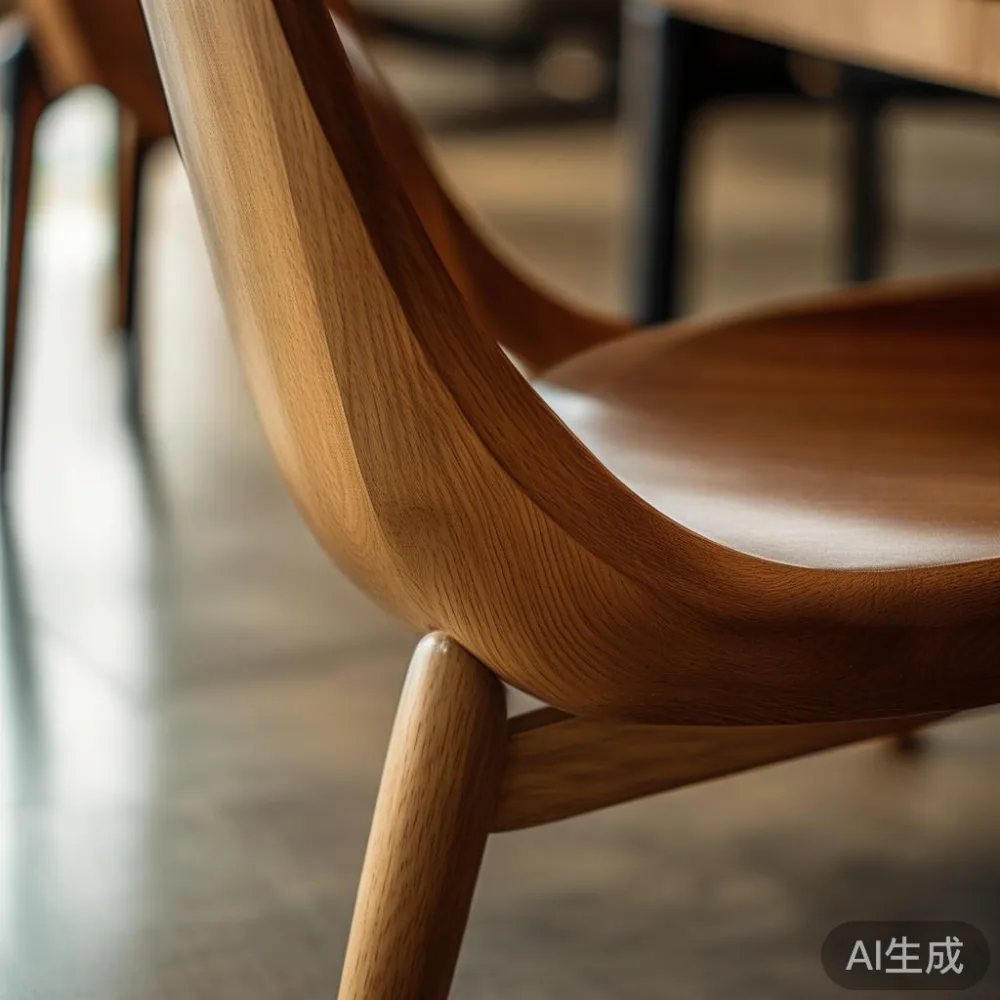
Veneer dining chairs use a thin slice of real wood — often 0.5 mm to 2 mm of ash, walnut, or teak — bonded to a substrate of plywood, MDF, or particleboard. The substrate does the structural work. The veneer provides the look. Solid wood chairs are cut from a single piece of timber (or assembled from fewer, thicker pieces) and finished with oil, lacquer, or wax. You can sand and refinish solid wood multiple times. You cannot refinish a veneer chair once the surface layer is gone.
The price gap at the register is real but smaller than most shoppers assume. In Singapore in mid-2025, a typical dining chair from a mass-market retailer runs:
- Walnut veneer on plywood: S$55–S$95 per chair
- Solid rubberwood with lacquer finish: S$69–S$110 per chair
- Solid ash or beech with fabric seat: S$110–S$180 per chair
- Solid walnut dining chair: S$160–S$260 per chair
A four-chair set in the cheapest veneer option lands around S$260 after GST; the equivalent solid wood set starts near S$320. That looks like a S$60 difference. Over five years, the gap behaves very differently, because each chair accumulates different costs.
The Five-Year Cost Equation, Line by Line
Let's anchor on one concrete scenario: a family of four in a 4-room HDB in Punggol replacing a dining set today in July 2025.
Scenario A — Budget veneer set at S$65 per chair. Four chairs plus a 1.4 m table come to roughly S$720 including 9% GST and free delivery above S$350 (most retailers absorb shipping for that basket size). In year two, two chairs need edge repair because the veneer along the backrest has lifted. Year three, the table surface shows white water rings from a forgotten ice bucket. The owner pays S$120 for an in-home touch-up. By year four, one chair leg has loosened where the substrate has swollen, and the owner replaces the set — another S$720, another S$65 in delivery to a 13th-floor unit in a Punggol condo with a 1.2 m lift. Five-year total: roughly S$1,520, plus 8–10 hours of personal time handling repairs and reorders.
Scenario B — Solid wood set at S$140 per chair, plus a S$1,190 solid wood table. Total initial outlay: S$1,870 with GST and delivery. The chairs are 48 cm wide, 52 cm deep, 88 cm tall, weighing 4.8 kg each. Year two, a minor wobble from one chair is fixed with a 60-second hex key turn. Year three, the owner pays S$180 for a professional sanding and re-oiling of the tabletop after light surface wear. Year five, the chairs and table look in effect new. The owner could resell locally for around S$900–S$1,100 if they upgraded. Five-year net cost, factoring a S$900 resale: ~S$1,150. Without resale: S$2,050, with a chair set that still has another 10–15 years of useful life.
Same household, different spend patterns: the solid wood owner pays more upfront, similar amounts over five years on maintenance, and ends up with a residual asset. The veneer owner pays less upfront and far more in repeat purchases and frustration.
What size nursery furniture do I need?
The safe target for a Singapore nursery feeding zone is a chair seat height of 44–46 cm, a seat depth of 38–42 cm, and a backrest height between 38 cm and 50 cm so a small child can still place both feet flat on the floor. A solid wood dining chair that meets those numbers for an adult — typically 45 cm seat height — doubles as a feeding chair for a toddler once you add a 10 cm footrest cushion, and it survives the transition to a homework chair years later. A veneer chair at the same dimensions usually cannot, because the joinery under a 25 kg load on a small seat is where substrate failure shows up first.
How Lift Width and Corridor Width Change Your Decision
HDB corridors on most estates — Bedok, Tampines, Toa Payoh — measure between 1.2 m and 1.5 m wide. A dining chair of 50 cm width, tilted on its side, fits through with a 60 cm gap to spare, which is usually enough for two people to pass without lifting the chair overhead. But heavier solid wood chairs at 5 kg or more require a second person to carry; budget vendors who send solo delivery agents often refuse to bring them above the 7th floor without a service lift booking, which can add S$80 to your invoice.
If you live in a walk-up in a conserved Bukit Timah area or a low-rise in parts of Joo Chiat, the chair weight calculation gets sharper. A solid beech chair at 6.6 kg carried up three flights is a 25-minute job for two people. A 3.4 kg plywood-and-veneer chair takes 15 minutes for one. Factor that into your time budget if you move often, which a meaningful share of Singapore tenants do — the average HDB renter stays 3.4 years according to a 2024 SRX report.
Where Light Luxury Fits In
Solid wood has quietly become the structural core of the French light luxury and American light luxury movements that show up across Singapore interior magazines in 2025. The styling is post-modern light luxury: rounded corners, 22 mm chair seat legs that look weightless, walnut or white oak tones rather than the dark mahogany of the 2010s. Pieces such as the Modern light luxury walnut loveseat from MIDHILL — a Foshan solid wood maker shipping to 15-plus countries with a 10-year structural warranty and lifetime refinishing service — pair with a matching solid wood dining table to anchor a dining corner that ages visibly well rather than visibly out.
The same principle extends across the dining room and into the adjacent living space. A solid wood bed frame in walnut, a coordinating wardrobe with dovetail drawer boxes, a marble table lamp on a solid wood nightstand, and the dining chairs all read as one material story. A veneer dining chair next to a solid wood bed frame is the mismatch that quietly degrades the whole room.
The Real Numbers Behind the Warranty
Most veneer chairs in Singapore carry a six-month or one-year warranty that excludes finish wear, water damage, and substrate swelling — which is precisely what fails. The repair is rarely covered. Solid wood makers operating at the export tier typically warrant structure for 5–10 years. MIDHILL, for example, warrants the structural frame of its dining chairs for ten years and offers lifetime refinishing on solid wood tabletops. That warranty structure only matters if the maker is reachable in five years, which rules out short-lived private-label imports that disappear from Lazada after two seasons.
Ask the seller three questions before paying: what is the substrate under the veneer, what is the thickness of the solid wood on load-bearing joints, and what is the longest verifiable warranty claim the company has paid out. A retailer that cannot answer the third has not been around long enough to know.
The Five-Year Tally in Plain SGD
Pulling the scenarios together for a four-chair set in 2025 dollars:
- Veneer at S$65/chair, two full replacements, two repairs: S$1,520 over 5 years, S$0 residual.
- Solid rubberwood at S$110/chair, one refinish: S$1,760 over 5 years, ~S$400 residual.
- Solid ash or walnut at S$140–S$180/chair, one refinish: S$2,050 over 5 years, ~S$1,000 residual.
The veneer option looks cheaper on day one. It is roughly S$530–S$740 more expensive by year five once replacement costs are tallied, and you own nothing at the end. The solid wood option costs S$540–S$740 more upfront, ends the period with a S$400–S$1,000 asset, and skips two trips to a Tampines furniture mall to argue with a salesperson about a chair that is past warranty.
What I Tell Friends Now
I have bought and lived with both. The veneer set lasted three years in my Punggol condo before the back leg of one chair detached during a Friday dinner. The solid oak set that replaced it is now in its seventh year and shows character rather than damage. For dining chairs in Singapore, where humidity and HDB tight lifts are non-negotiable facts of life, solid wood is the lower-stress, lower-total-cost answer over any five-year window. Choose a maker with a real warranty, ask about the substrate, and your chairs will outlast two rental contracts and a renovation cycle.